How Should a Suit Fit? A Guide to Getting It Right
Most men know their suit size. But they don’t often know what a properly fitted suit should look and feel like. The difference is not just whether the jacket buttons or not.
A good fit starts at the collar and shoulders, follows the shape of your chest and waist, and ends with the right trouser length and break. Some details can be changed through alterations. Others, like the shoulders and collar balance, need to be right from the start.
Here is what to check, from the collar down to the trouser hem, before you decide a suit is the one. Start at the top, the same way a fitter does.
Start at the Collar: Your First Fit Checkpoint
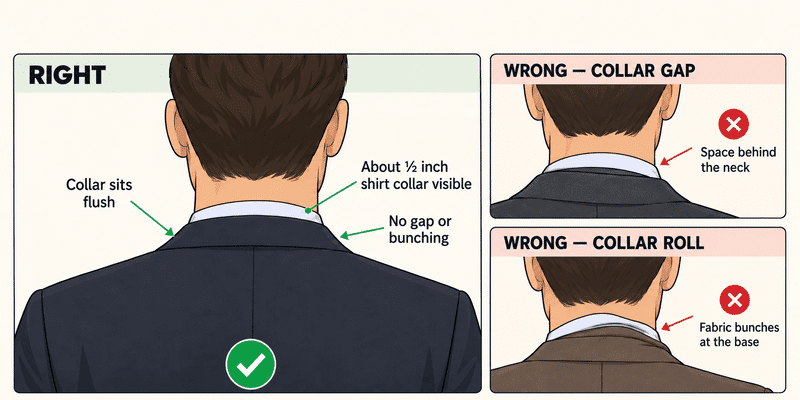
The collar tells us more than neck size. It shows whether the back and shoulders of the jacket match the man wearing it.
A correctly fitted collar is simple to spot:
- The jacket collar rests flush against your shirt collar
- About half an inch of shirt collar shows above it
- No space behind the neck
- No fabric piling up at the base
Two problems may show up here:
- Collar gap: The jacket has pulled away from your body. Usually the balance is off.
- Collar roll: Fabric bunches behind your neck. This is common on men who stand with a forward-head posture or carry a fuller upper back.
Neither is a quick fix. A collar that will not sit properly is telling you the jacket was cut for a different back shape than yours.
Alterations rarely solve that cleanly. Look at a different cut instead.
Shoulders: The One Area to Get Right the First Time
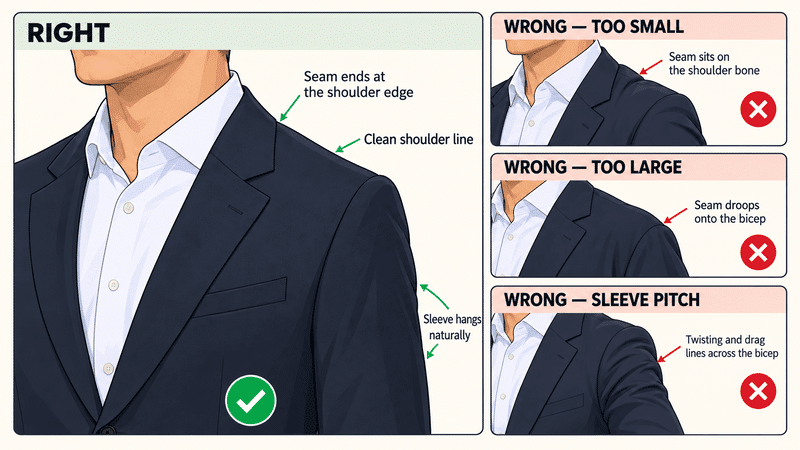
Find the shoulder seam. Run your finger along it. It should stop exactly where the flat plane of your shoulder starts to curve down into your arm.
Bad shoulder fit announces itself. Here is what to look for:
- A divot below the seam: The sleeve head is fighting the shoulder.
- Rippling across the top: Too much padding or too much width.
- A seam sitting on the shoulder bone: The jacket is too small.
- A seam drooping onto the bicep: The jacket is too large.
This checkpoint matters more than any other. Shoulders are built, not adjusted.
Reconstructing one means opening the jacket at the sleevehead. The result is often worse than where you started. So if the shoulder is wrong, change the jacket.
One more thing worth watching: sleeve pitch. That is the angle at which the sleeve hangs from the armhole. Let your arms drop naturally at your sides. The sleeve should follow the line of your arm without twisting or dragging fabric across the bicep.
Arms that sit slightly forward need a sleeve set to match. A good fitter catches that during the first fitting.
Chest and Lapels: The Closed-Fist Test
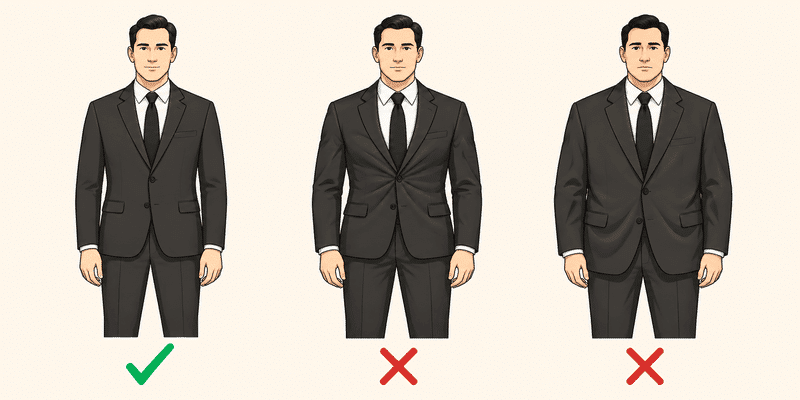
Button the jacket. Slide a closed fist between your chest and the fabric. That is the room you want. Snug against the body, with nothing straining.
A chest that runs too tight will show it in the lapels. They lift and gap away from your chest, and the effect gets worse the moment you reach for something or turn at the waist. Some fitters call this the X-pull, named for the creases that fan out from the button.
Too loose is easier to miss. The lapels lie flat, but the jacket has no shape through the body and the fabric collapses inward when you move.
Good news here. Unlike shoulder issues, chest and lapel issues fall well within what a skilled hand can correct. Suppression can be added through the side seams or released to open the chest.
The jacket sleeve stops at your wrist bone. About half an inch of shirt cuff shows below it.
- Too little cuff, and the sleeve looks unfinished and heavy at the hand.
- Too much cuff, closer to an inch and a half, and the jacket looks like it belongs to a smaller man.
Check both arms. Most men have one arm slightly longer than the other. A proper fitting accounts for that difference instead of splitting it down the middle.
Sleeve length is one of the fastest and cheapest adjustments a fitter makes. If a jacket is half an inch off at purchase, that alone is no reason to walk away.
Jacket Length and Waist Suppression
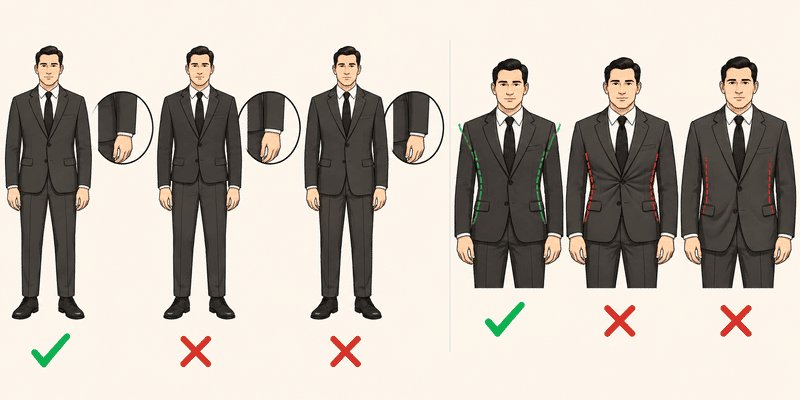
Let your arms hang at your sides. Curl your fingers slightly. The hem should land where your fingers meet your palm.
It also has to cover your seat completely. Proportion complicates this rule:
- Long torso, short legs: the jacket runs shorter than the finger rule suggests
- Short torso, long legs: the jacket runs longer
Now the waist. A jacket should taper gently from the chest down, creating a clean V through the body.
That taper is called suppression. It distinguishes a jacket with shape from one that hangs like a bag. The limit is easy to test:
- Button the jacket
- Sit down, then stand up
- Walk a few steps
Watch for creases pulling at the button or fabric bunching at the hip. Either one means the waist has been taken in past what your body allows. Suppression should flatter, never restrain.
Armholes and Freedom of Movement
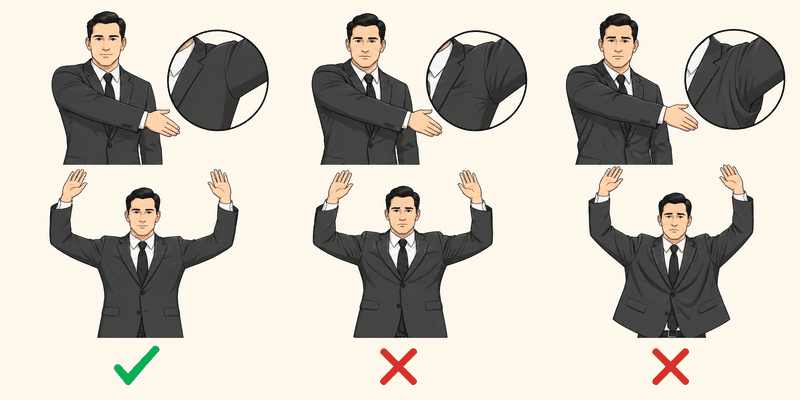
Most men never test this one. Put the jacket on, button it, then reach across your chest as if shaking hands with someone on your left. Raise both arms. A well-cut jacket comes with you, with minimal drag at the shoulder or across the upper back.
Armhole height explains the difference. A higher, closer armhole keeps the jacket still while your arm moves, which is why traditional tailoring cuts them high. A low, roomy armhole pulls the whole jacket sideways the moment you lift your arm.
Trousers: Waist and Seat
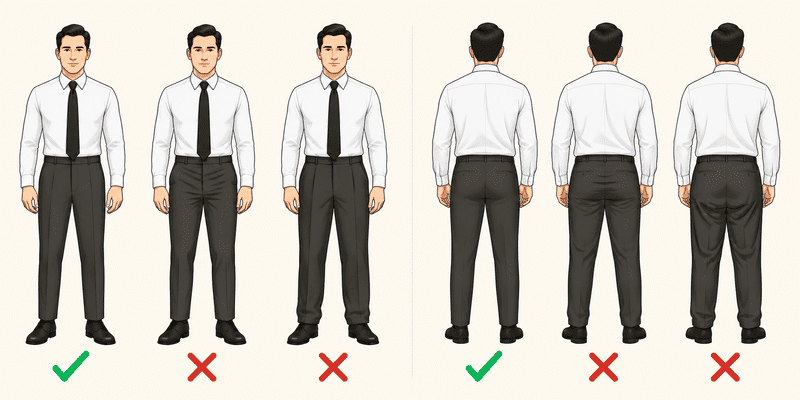
Trousers should sit at your natural waist, just above the hip bone, and stay there on their own. A belt refines the fit. It does not hold the trousers up.
Test the waistband with two fingers. Slide them inside at the front:
- Comfortable, and you can sit without the button digging in? The waist is right.
- Have to suck in? Size up.
- Waistband slides down as you walk? Too big.
The seat should follow your shape smoothly. Two faults to look for:
- If fabric is stretched tight across the back, with horizontal pull lines, the seat is undersized.
- If there are loose folds below the seat, or cloth flapping around the thigh, too much fabric.
Good news: both the waist and seat fall within what a fitter can adjust, usually with room to move either direction.
Trouser Break and Length
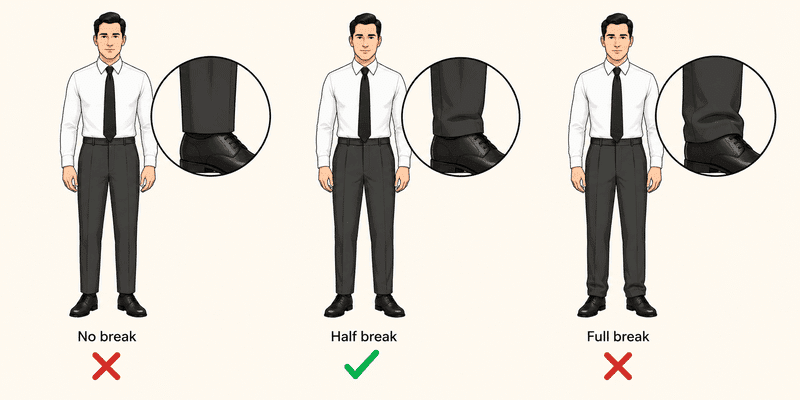
The break is the fold where the trouser hem meets the top of your shoe. How much to fold is a style decision, not a rule.
Here is the range:
- No break: The hem stops right at the shoe. Clean, uninterrupted line.
- Half break: One soft fold. The middle option.
- Full break: More fabric rests on the shoe. Traditional, with visible creasing.
Not sure which you want? Take the half break. It reads well in an office and holds up at a wedding. It also works with nearly every shoe you own. Formality shifts things slightly.
Hemming is straightforward work. So this is one checkpoint you can correct exactly, no matter what size you started with.
Off-the-Rack, Made-to-Measure, or Bespoke?
Look back at what we covered. Some fit problems cost you fifteen minutes and a modest fee:
- Sleeve length
- Trouser hem
- Minor waist suppression
- Seat adjustment
Others are structural. No fitter can fully undo them:
- Shoulders
- Collar balance
- Armhole height
That split explains why the way you order your suit matters. Let’s compare:
- Off-the-rack: You pick the stock pattern closest to your build, then correct outward from there. It works well if your proportions are close to the pattern’s assumptions. Less well if they do not.
- Made-to-measure: An existing pattern gets adjusted to your measurements. You improve your odds on chest, waist, and length. The base shoulder construction and armhole geometry remain largely as intended by the pattern.
- Bespoke tailoring: A pattern is drafted from your measurements and your posture. That includes how you carry your shoulders and how your back is shaped. A sample garment is then used to confirm the fit before final construction begins.
Getting a fully custom suit might take longer. But unlike made-to-measure and off-the-rack options, bespoke tailoring puts the hard-to-alter checkpoints in the right place from the start. No one has to rescue them later.
Your Next Steps Toward a Suit That Fits Well
A good fit is a sequence of small checks running from the collar to the hem, and most suits that feel “almost right” are one or two of those checks away from being right.
Sort them by what you can change. Sleeve length, trouser break, waist suppression: these you can fix any time. Shoulders, collar balance, overall balance through the back: these you cannot.
Starting with a garment built to your own measurements and posture removes the guesswork from the ones that count.
At Alan David Custom, five generations of master tailors have spent over a century getting these details right. Your measurements are taken by a master fitter, not by sales staff. Come by our New York showroom for a second opinion on the suit you already own, or to have one built around your measurements. Book your appointment online.