How to Choose a Custom Suit: 12 Tips From NYC Master Tailors
Most men buy their first custom suit with one goal in mind: something that fits properly for once. That is the right instinct. Getting there takes a few decisions made in the correct order, starting with terminology and ending with the tailor you hand your money to.
The twelve points below follow the same sequence we walk clients through in our New York showroom. Read them once before your first appointment, and you will ask better questions and end up with a garment that truly fits you.
1. Understand What “Custom” Means
In the world of suit tailoring, three distinct tiers exist, and the price difference between them is huge. Those three are: off-the-rack, made-to-measure, and bespoke.
- Off-the-rack garments come in standard sizes built to a manufacturer’s average body. A local alterations shop can adjust the waist, the sleeve length, and the trouser hem. The shoulders and the chest stay as they are. But, compared to the other two options, it costs the least.
- Made-to-measure starts from an existing block pattern and adjusts it to your measurements. Expect somewhere between 10 and 20 measurements, a decent range of fabric and style options, and usually 1 fitting before delivery.
- Full bespoke begins with no pattern at all. A cutter drafts one from scratch for your body, records your posture and imbalances, and builds a garment around them. 20 to 30 measurements are normal. So are multiple fittings.
Understand how true bespoke tailoring differs from the alternatives before you commit to a tier.
2. Fit Beats Fabric, Color, and Everything Else
Human bodies are rarely symmetrical. One shoulder usually sits lower than the other, one arm often runs slightly longer, and posture pulls the cloth in ways a stock pattern cannot anticipate. A stock size simply has no way to account for them.
The shoulder is the one area of a jacket that cannot be corrected cheaply after the fact. Rebuilding a shoulder means taking the jacket apart. That is why it’s important to get it right at the pattern stage.
Two checks to keep in mind at your fitting:
- The sleeves should hang cleanly from shoulder to wrist with no pulling or wrinkling at the bicep
- The top button should close at the fullest part of your stomach. Higher than that adds visual weight. Lower shows too much of the shirt and throws off the balance, which looks bad on a tuxedo.
3. Set a Realistic Budget for Your Suit
Prices vary by city, mill, and construction method, so treat the following as broad ranges rather than quotes.
| Tier | Typical range | What drives the price |
| Off-the-rack | $150 to $1,000 | Brand, fabric grade, factory production |
| Made-to-measure / custom | $800 to $2,500 | Pattern adjustment, fabric choice, one fitting |
| Full bespoke | $1,300 and up, beyond $6,500 | Hand-cut pattern, canvas construction, multiple fittings, hand-sewing hours |
Four things move the number: the cloth itself, the internal construction, how much of the garment is sewn by hand, and how many fittings the house includes. A shop quoting a bespoke price with a single twenty-minute appointment is selling made-to-measure. Ask which one you are buying.
4. Match the Suit to How You Will Wear It
Buy a suit for your planned events. A suit worn three days a week in an office needs a durable mid-weight worsted fabric in a color that repeats without drawing attention. A suit worn twice a year for weddings and formal events can carry more character in the cloth and more detail in the styling.
Travel changes the answer again. High-twist wool resists creasing and recovers after a night folded in a garment bag. Soft flannels do not.
Tell your fitter how often you put the garment on, where you sit, and what you carry in your pockets. Those answers shape the fabric weight and the construction.
5. Start Classic if This Is Your First One
Navy first. Medium grey second. Charcoal third. That order has held for decades because those three colors work for the major events you might attend: an interview, a funeral, a client dinner, and a Saturday wedding without a dress code.
Save the windowpane check and the tobacco brown for suits four and five, once the plain ones are earning their keep. Our guide to the best suit color choices covers when the less common shades make sense.
6. Choose Fabric for the Season and Quality
Worsted wool works year-round, which is why most first suits are made from it. Heavier cloths, flannel and tweed among them, hold shape in cold weather and drape beautifully.
For summer, look at linen, cotton blends, and open-weave wools that let air move. Our notes on lightweight summer suits go deeper on warm-weather cloth.
Roughly speaking:
- 7 to 9 oz cloth suits hot weather but wrinkles more easily
- 9 to 11 oz cloth handles most of the year in a temperate climate
- 12 oz and heavier gives structure, drape, and years of service
Super numbers describe yarn fineness, not durability. Super 150s feels wonderful and wears out faster than Super 110s. For a suit you plan to wear weekly, lower is smarter. \
English and Italian mills such as Holland & Sherry, Dormeuil, Loro Piana, and Zegna publish their weights and compositions openly, which makes them easy to compare.
7. Learn the Difference Between Fused, Half-Canvas, and Full-Canvas
The layer between the outer cloth and the lining decides how a jacket holds its shape. Most buyers never ask about it. They should.
| Construction | How it is built | What to expect |
| Fused | Interlining glued to the shell | Lowest cost, flat chest, can bubble or ripple after repeated cleaning |
| Half-canvas | Canvas sewn through the chest and lapels, fused below | Solid mid-tier standard, good lapel roll, reasonable lifespan |
| Full-canvas | Canvas sewn throughout the body | Best drape, molds to your shape over time, highest labor cost |
Full canvas is standard in true bespoke for a reason. The horsehair layer moves with you and gradually takes on the shape of your chest, which is why a well-made suit tends to fit better in year five than year one.
Ask the shop directly which construction they use. A straight answer is a good sign.
8. Get the Style Details Right
These choices shape how a suit looks and feels. Take them one at a time.
Lapels
| Style | Best for |
| Notch | Standard business wear, the default for a first suit |
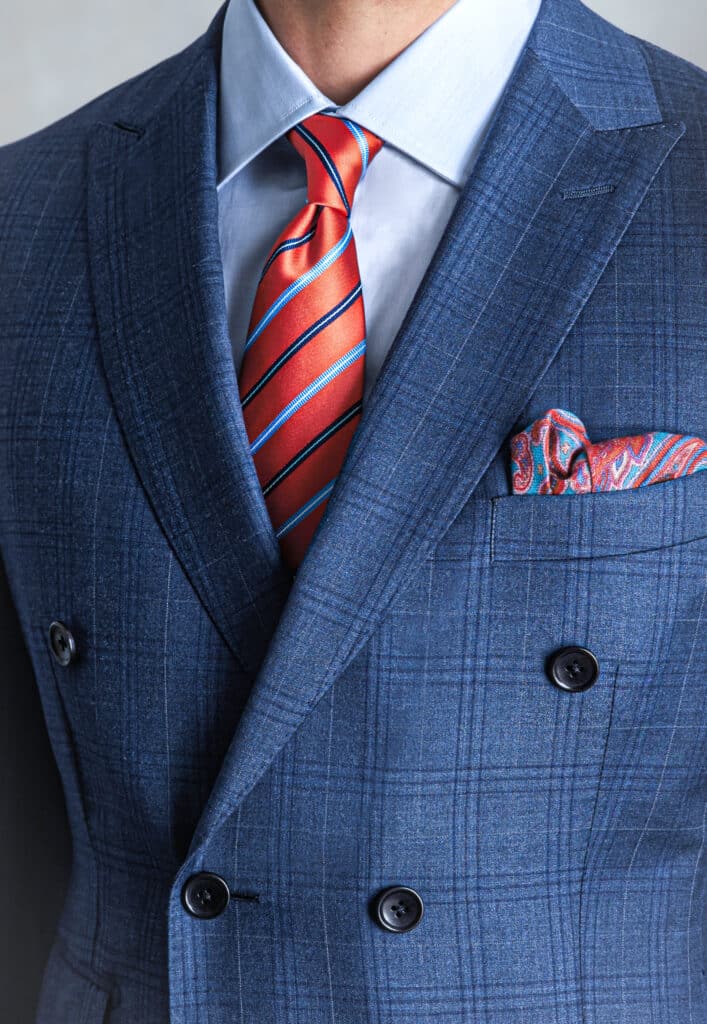
| Peak | Added formality and a little width across the chest |
| Shawl | Dinner jackets and tuxedos only |
Vents
Vents decide how the jacket sits when you move:
- Side vents: the English preference. The line stays clean when your hands go in your pockets.
- Center vent: common, slightly more casual, easy to wear.
- No vent: formal, and it restricts movement when you sit.
Pockets
- Flap: business suits
- Jetted: formalwear and tuxedos
- Patch: soft sport coats
Button Stance
This ties back to Tip 2. The closing button sits at the fullest part of your stomach. That placement comes from proportion, not fashion.
Shoulder Structure
Structure is a choice, not a rule. Light padding sharpens the line on a slim build and reads well in conservative offices. Heavy padding on an already broad frame looks like armor.
9. Choose a Silhouette That Suits Your Build
Trouser break is where most men go wrong:
- A full break puts a distinct fold across the shoe and gives a traditional look.
- A slight break shows one soft crease.
- No break leaves a clean line at the shoe top and looks sharpest on lean builds.
Some general guidance from the fitting room:
- Trim and thin builds benefit from cloth with weight and drape. Flannel and heavier worsteds fill the frame in a way that thin summer cloth cannot.
- Shorter men look taller with a slight or no break, a higher button stance, and minimal contrast between jacket and trouser. Our guide on suit considerations for a shorter man covers the proportions in detail.
- Broad and muscular builds should be careful with cropped jacket lengths and heavy padding. Both exaggerate width. A slightly longer jacket with a clean shoulder balances the upper body far better.
10. Judge the Tailor Before You Judge the Fabric
One rule above all others: never allow a salesperson to take your measurements. A master fitter or cutter should measure you, because reading posture, shoulder slope, and stance is a trained skill that takes years to develop.
Ask these questions at your first visit:
- Who takes the measurements, and who drafts the pattern?
- Is a sample or basted garment made before the final cut?
- How many fittings are included, and what happens if the first one misses?
- What is the alterations policy after delivery?
Red flags are easy to spot once you know them. A five-minute measuring session. No discussion of your posture or how you stand. Vague answers about construction.
Besides, a finished gallery of completed work tells you more than any brochure.
11. Know the Fitting Process and the Timeline
A proper commission runs in stages. The consultation comes first, where you discuss use, budget, and cloth. Measurements follow, taken by the fitter. A patternmaker then interprets those dimensions and drafts the pattern.
Next comes the sample or basted garment, which exists to confirm the fit before anyone cuts the finished cloth. Adjustments get marked on your body. The final garment is then cut to those exact corrections. You can see each stage laid out in our custom suit process.
Timing depends on the tier. Made-to-measure usually runs 3to 5 weeks. Full bespoke with several fittings often takes 6 to 12 weeks.
Rush work is possible at houses set up for it; we produce custom suits in as little as ten working days when a client’s timeline demands it, though the standard schedule always produces the better result.
12. Treat It as a Long-Term Purchase
Many men run after trends. But trend-driven details go out of style fast. Very narrow lapels, cropped jackets, and extreme tapering all looked current at some point and now mark a suit by its year. Classic proportions do not have that problem.
Care extends the life considerably:
- Use a wide contoured hanger that supports the shoulders.
- Brush the cloth after wear.
- Rest a suit at least a day between wearings so the fibers recover.
- Dry clean sparingly, twice a year at most, since the solvents wear on wool over time.
- Steaming handles most issues, and our short guide to de-wrinkling a suit at home covers the rest.
Final Thoughts
A good custom suit is the product of decisions made in order. Settle the tier first, then the budget, then the cloth, then the construction. Fit carries the rest. If the shoulders sit right and the balance is clean, everything else is detail work.
Take your time at the first appointment. Ask who measures you, who drafts the pattern, and how many fittings you get. The answers tell you what you are buying long before the garment arrives.
Five generations of tailoring stand behind what we make at Alan David Custom, including the last fully hand-sewn collection made in the USA through our partnership with Oxxford Clothing. Our Perfect Fit Guarantee and free lifetime alterations exist for one reason: a suit should still fit you years from now. Book an appointment today and visit our New York showroom for wedding garments, custom tuxedos, or a no-pressure conversation about your suit.