Wedding Guest Suit Guide: How to Match Any Dress Code (2026)
Choosing a suit for a wedding isn’t always as simple as wearing your best one, especially when you’re a guest. You’re not the groom. You’re not a groomsman standing up front with the wedding party. There’s no group chat sorting out ties, no outfit hanging in a garment bag with your name on it. Just you and two words on an invitation that sound official and explain almost nothing.
Those two words are only part of the answer. Where the wedding happens changes things. So does the hour it starts. And what the couple had in mind matters more than any rule you’ll read online.
So let’s go through it. In this guide, we’ll cover dress codes, colors, fabrics, fit, shoes, and etiquette so you walk in dressed correctly for any kind of wedding.
What to Wear by Dress Code at a Glance
| Dress code | What a male guest wears |
| Black tie | Tuxedo, black bow tie, polished black shoes |
| Black tie optional/formal | Tuxedo, or a dark navy, charcoal, or black suit with a tie |
| Semi-formal / cocktail | Suit in navy, grey, or a seasonal shade; tie usually expected, sometimes optional |
| Casual or garden | Blazer with dress trousers, open collar or knit tie |
| Beach or destination | Light linen or cotton suit, loafers, no tie |
| No dress code listed | Read the venue and the hour, then match the formality |
How to Choose a Wedding Guest Suit That Fits the Dress Code
Most invitations name a dress code. Guests are expected to follow it. Here is what each one requires.
Black Tie
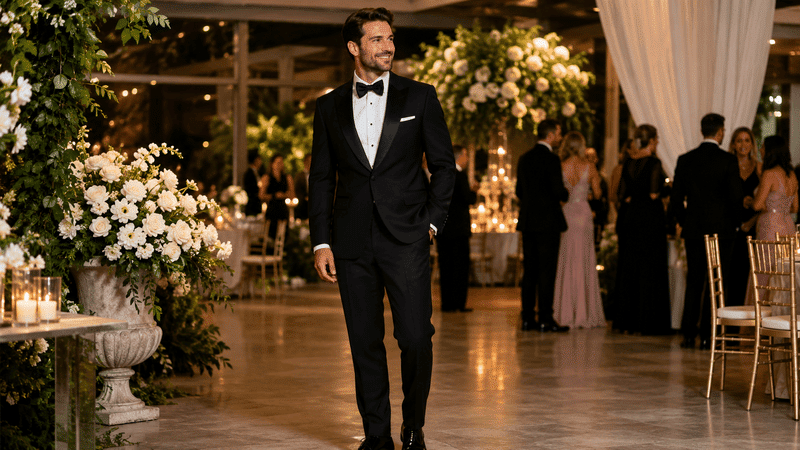
When the invitation says black tie, you wear a tuxedo with a black bow tie. A regular suit will not pass. Even a very dark suit reads as underdressed in that room.
One fit note that applies to every tuxedo: the top button should close at the fullest part of your stomach. Higher makes you look heavier. Lower shows too much shirt and throws the whole front of the jacket out of balance. On a tuxedo, that mistake is impossible to hide.
Black Tie Optional or Formal
A dark suit works as an alternative to a tuxedo. Navy, charcoal, and black all belong here. If you own a good suit and prefer it to a rental tux, wear it with confidence.
A midnight blue tuxedo sits nicely between the two. Under evening light, it reads slightly richer than black, and it photographs beautifully. Many men who buy their first tuxedo choose midnight blue for exactly that reason.
Semi-Formal or Cocktail
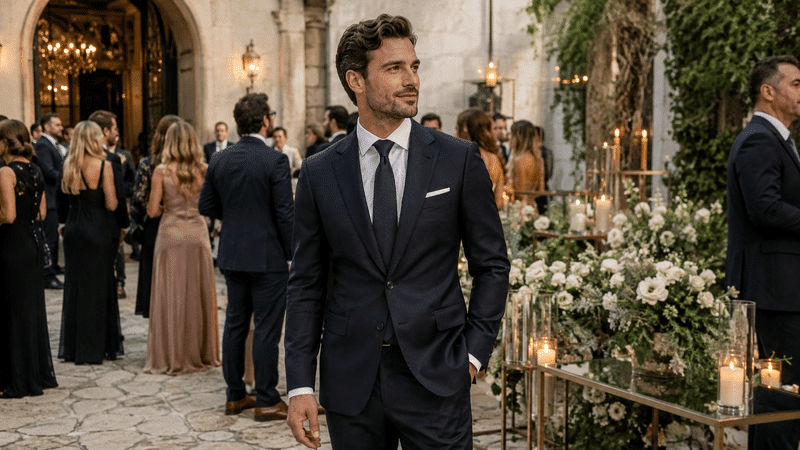
This is the dress code guests get wrong most often. It’s the most common one and the least understood. You have room to play with color and texture, but the suit still has to fit properly. Cocktail is not permission to dress down.
At many semi-formal or cocktail weddings, a tie is optional. That works only with the right shirt.

Casual or Garden Wedding
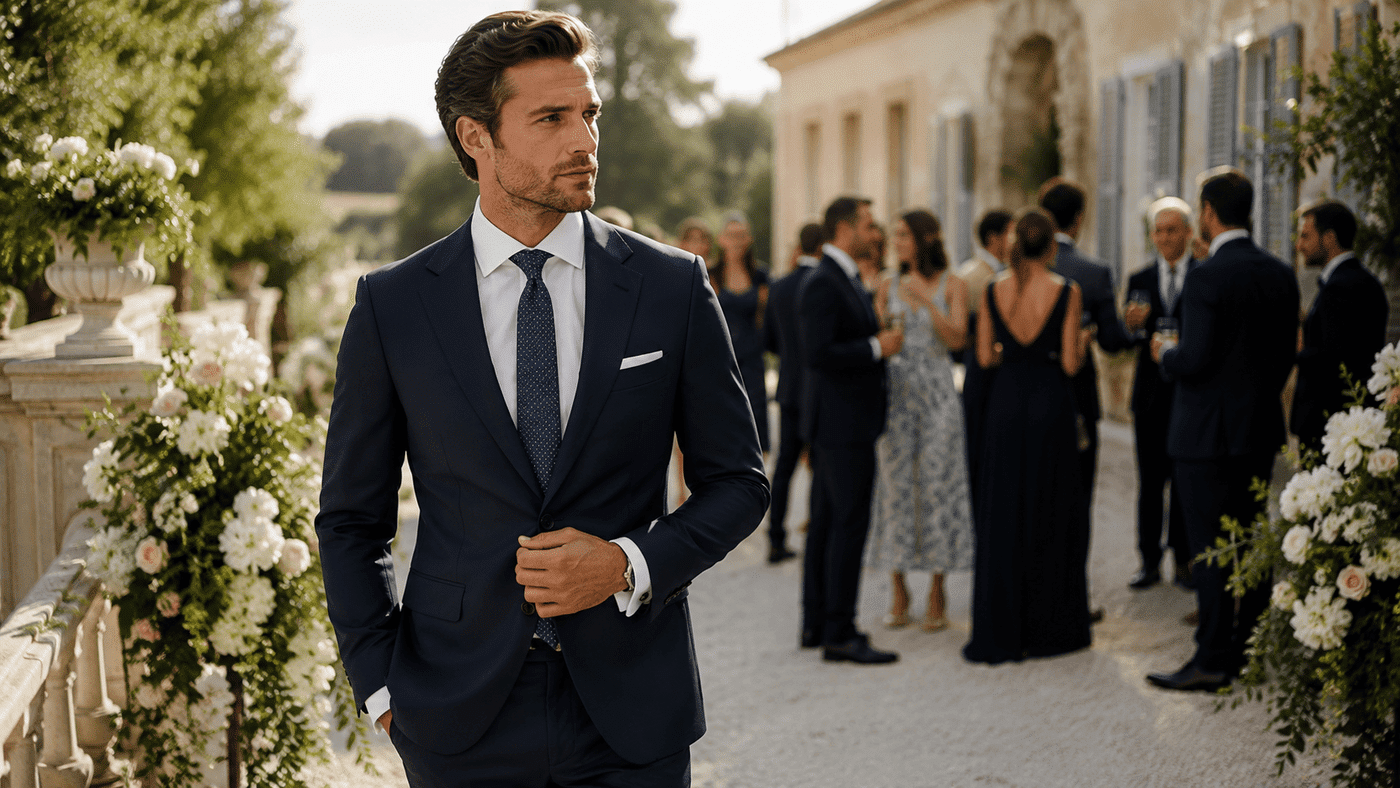
A full matched suit becomes optional here. A blazer with contrasting dress trousers does the job, as does a lighter suit in a soft shade. Garden ceremonies suit sage, dusty blue, tan, and light grey.
Casual at a wedding still means dressed. It never means what you’d wear to a cookout.

Beach or Destination Wedding
A beach wedding requires breathable cloth above everything else. Linen, cotton, or a linen-wool blend in sand, stone, light blue, or off-white. Skip the tie. Open the collar.
Footwear deserves real thought here. Loafers worn with no-show socks work well on hard ground. Leather sandals suit sand. Heavy oxfords do not belong on a beach, and neither do sneakers.
Creative or Themed Dress Codes
“Festive attire” usually means a standard suit with a seasonal accent. A deep green tie, a burgundy pocket square, something small. “Creative black tie” means the tuxedo stays, but the shirt, bow tie, or velvet jacket can carry personality.
The rule under both labels stays the same. Keep the base formal and put the personality in one accessory.
No Dress Code Listed? Read the Venue and Time Instead
A ceremony starting at five o’clock in a hotel ballroom asks for something entirely different from a noon service in a vineyard. Match the hour and the room, and you’ll rarely be wrong.
| Setting | What it calls for |
| Daytime, outdoors | Lighter colors, breathable cloth, softer shoes |
| Daytime, indoors | Mid-grey or navy, standard suit, leather oxfords or derbies |
| Evening, outdoors | Darker suit, heavier cloth, layer for temperature drops |
| Evening, indoors | Charcoal, navy, or black, dress shirt and tie |
What Color Suit to Wear as a Wedding Guest
Choosing the right suit color for a wedding is about matching the day’s mood. The same cut reads more or less formal depending on the shade.
Navy and charcoal grey carry across nearly every dress code and every season. Both photograph well. Both pair with almost any shirt and tie you already own. If you buy one suit for weddings, buy it in one of those two.
Black is appropriate for formal evening weddings, especially indoors. Reconsider it for a daytime garden ceremony. In some religious and cultural traditions, black carries a somber tone. If the ceremony starts before five and takes place outside, reach for navy.
Warm weather and daytime events open the palette:
- Tan and light grey work beautifully outdoors.
- Sage and dusty blue read fresh and sit well against greenery.
- Olive, burgundy, and dusty rose have become common at autumn and spring weddings, usually in a jacket paired with neutral trousers.
Softer shades signal that you read the invitation and thought about the setting. Whatever you choose, avoid all-white, ivory, and cream. Those belong to the bride.
Can a guest wear the same color as the groomsmen? Similar is fine. If the groomsmen wear navy and you own navy, don’t wear it. Pick another suit, a different shade, a patterned tie, or a lighter shirt.
When in doubt, ask someone in the wedding party what color they’ve chosen. Most are happy to tell you.
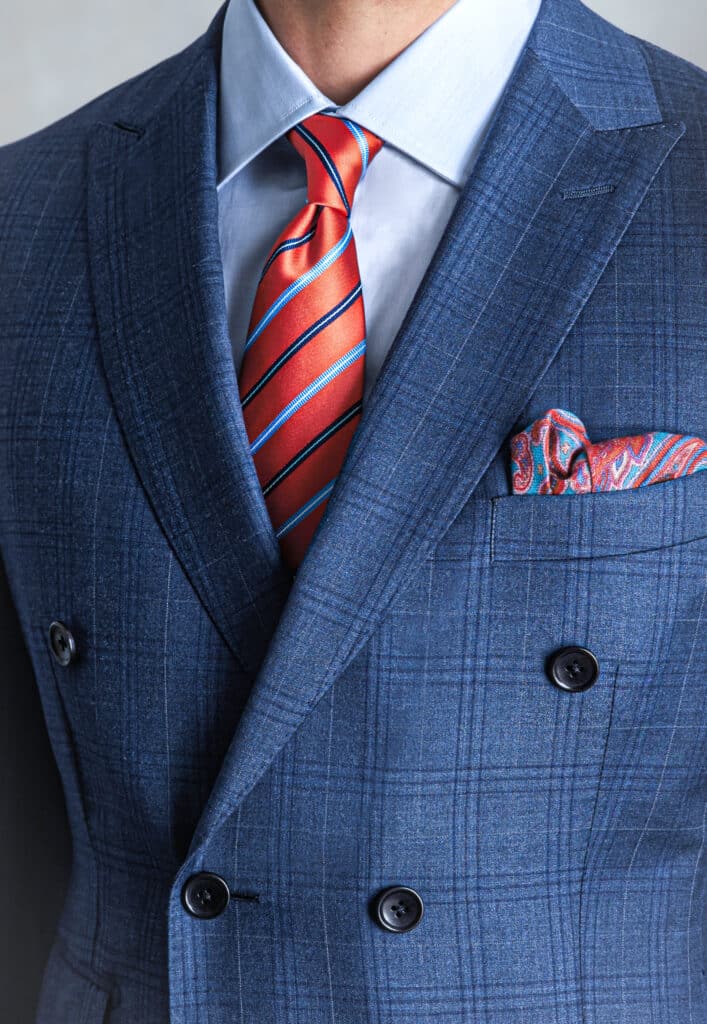
The red tie superstition still circulates, by the way. The old story says a man in a red tie is signaling a past romance with the bride. Enjoy the tale, then pick your tie based on the suit.
Choosing Suit Fabric by Season and Venue
Fabric determines how comfortable you are all day, not just how sharp you look walking in.
Fabric at a Glance
| Season/setting | Best cloth | Why it works |
| Fall and winter | Wool, flannel | Holds its shape, resists wrinkling, reads formal indoors |
| Spring and summer | Linen, cotton, linen-wool | Breathes in heat and direct sun |
| Unpredictable or shoulder season | Tropical wool (fresco) | Handles warmth better than worsted, creases far less than linen |
| Beach or destination | Linen, cotton blends | Lightest option, forgiving in humidity |
Fall and Winter
- Wool and flannel are the standard. Both hold their line through a long reception.
- Weight matters more than color. A mid-weight wool carries a natural formality that suits an indoor ceremony.
Spring and Summer
- Linen, cotton, and linen-wool blends breathe far better in heat.
- This is not a small detail. Twenty minutes in direct sun during the ceremony will tell you everything about your fabric choice for a summer wedding.
Not Sure What Season You’re Dressing For?
Look at tropical wool. Some call it fresco. It sits between the two extremes:
- Cooler than standard worsted
- Recovers from creasing far better than pure linen
- Works from April through October in most of the country
Cold-weather ceremonies need a plan for the walk in. Think about the coat. A custom overcoat, cut to fit over a suit jacket, sits clean across the shoulders. Off-the-rack coats usually bunch up there. A dark solid scarf will finish the look.
Hand the coat off at the coat check, or take it off as you reach your seat. Not halfway through the ceremony. If the reception runs outdoors under heaters, keep it somewhere you can grab it.
The other thing worth remembering is how long the day runs. Ceremony, cocktail hour, dinner, then dancing. Your suit has to hold up through it all. Looking sharp for the first twenty minutes isn’t much of a win.
Suit Style: Two-Piece, Three-Piece, or Separates
Most guests default to a matched two-piece. There are two other options worth knowing.
Separates
A blazer with contrasting trousers reads a step below a matched suit. That works at semi-formal, casual, and garden weddings.
A navy jacket with grey trousers is the safest pairing in menswear. Keep the two pieces clearly different in tone. Slightly-off matching looks like a mistake rather than a choice.
Three-Piece Suits
Adding a custom vest raises the formality of the same suit without a tuxedo. It also solves a practical problem. When the jacket comes off during dancing, you still look dressed. The bottom button of the vest stays open. The vest should cover the waistband completely, with no shirt showing between vest and trousers when you stand.
A three-piece suit works for an evening wedding, a formal daytime ceremony, or a winter event. It’s a poor idea in August heat.
5-Point Fit Checklist Before You Buy or Alter Your Suit
Fit separates the guest who looks put together from the one who looks like he grabbed something an hour before the ceremony. Run through these five points in front of a mirror:
1. Shoulders: The seam should land where your shoulder ends and your arm begins. Not past it, not short of it. Divots or ripples below the seam mean the shoulder is too wide. This is the one thing alterations cannot fix well, so check it first.
2. Sleeves: Stand with your arms relaxed. Both sleeves should hang with a clean line from shoulder to wrist, with no wrinkling or pulling across the bicep. Sleeves attached asymmetrically pull at one side and never sit right. Show roughly a quarter to half inch of shirt cuff at each wrist.
3. Jacket length and button placement: The jacket should cover your seat. The top button should close at the fullest part of your stomach.
4. Collar gap: With the jacket buttoned, the collar should rest flat against your shirt collar all the way around. A gap between the two means the jacket is fighting your posture, usually at the neck or upper back.
5. Trouser break: A slight break, where the trouser touches the shoe once and stops, works for nearly every wedding. No break looks sharp on a slim cut. A full break, with fabric pooling on the shoe, looks careless in photographs.
Have a fitter or master cutter run the check with you if you can. Our custom suit guide covers measurement basics in more detail.
Off-the-Rack vs. Made-to-Measure vs. Custom
Here is what we see go wrong most often: a guest buys off the rack two weeks out, the shoulders are half an inch too wide, and no alteration fixes it in time. That is why it’s important to get the fit right from the start.
Off-the-rack is the fastest way to get a suit on your body and the least precise. These suits are built for an average frame, and most men don’t have one. A good fitter can take in a waist or shorten a sleeve. Once the shoulders and chest are wrong, though, there’s a limit to what needle and thread can repair.
Made-to-measure starts from an existing pattern and adjusts it to your measurements. It’s a real step up. You get a garment built closer to your shape without waiting months.
A custom suit reverses the order. Your measurements come first. A patternmaker interprets your dimensions, a sample garment confirms the fit, and the final piece is cut to the adjustments made at that fitting. Compared with made-to-measure, it takes longer and costs more. The fit beats anything else on this list. You can see each stage in our fitting process.
Start fittings or alterations at least three to four weeks before the wedding.
Renting vs. Buying a Suit
Renting makes sense for one situation: a black tie invitation when you own no tuxedo and expect no second occasion. The fit will be approximate, and you’ll know it.
Buying makes sense the moment you have a second event on the calendar. Two weddings in a year already close the cost gap, and you keep a garment cut to your body.
Accessorizing a Men’s Wedding Guest Outfit
The suit is the foundation. Details finish the look. The core kit includes: a custom dress shirt, a tie or bow tie, a pocket square, a belt, and a pair of good shoes.
Match your tie width to your lapel width. A wide tie against a slim lapel looks off, and the reverse looks off too. Keep them in proportion.
Pick one statement piece and stop. A bold tie or patterned socks can show personality. Both at once is too much. You’re there to support the day, not to pull eyes toward yourself.
Shoe and Belt Guide
Shoes carry more formality signal than most men expect.
| Shoe | Formality | Pairs with |
| Black patent or plain-toe oxford | Black tie | Tuxedo only |
| Black cap-toe oxford | Formal | Charcoal, black, navy |
| Dark brown oxford or derby | Semi-formal | Navy, grey, olive |
| Loafer (leather or suede) | Semi-formal to casual | Tan, light grey, blue, linen suits |
| Monk strap | Semi-formal | Navy, grey, burgundy |
Two rules cover the rest:
- Match your belt leather and color to your shoes.
- And keep the shoe darker than the suit, unless you’re wearing a light summer suit with tan or brown leather, in which case the reverse works.
When You Can Skip the Tie
Going without a tie is a decision, not a default. It works at semi-formal, casual, garden, and beach weddings. It does not work at black-tie or black-tie-optional events.
If you go open collar, the shirt has to hold its shape. A spread or semi-spread collar with light interlining stays up. Add a pocket square so the chest doesn’t look bare.
Jacket Etiquette
Keep your jacket on when you first sit down. Wait until the groom removes his, or until dinner is served. At a formal or traditional wedding, that small piece of timing shows respect for the occasion.
Our guide to wearing a suit covers more of these habits.
Get a Wedding Suit You’ll Wear Again
A suit bought for a wedding should earn its place in your closet. Pick classic colors and cloth that won’t date after one season.
Then build a small rotation around it:
- Two or three shirts in different shades
- A few ties, formal through relaxed
- A couple of pocket squares
- A second pair of trousers to wear with the same jacket
Swapping those pieces changes the look enough that no one clocks it as “the wedding outfit” every time. A good navy or charcoal suit carries you through future weddings, interviews, business dinners, and funerals.
Final Thoughts
When the invitation arrives, it’s normal to wonder what you should wear. Wedding dress codes aren’t always obvious, and few couples explain them in detail. Once you know how formal the day will be, the rest falls into place quickly.
At Alan David Custom, five generations of experience go into getting the fit right. Patterns are cut to your body. Fittings confirm the fit before the final garment is assembled. Visit our New York showroom or book an appointment.